
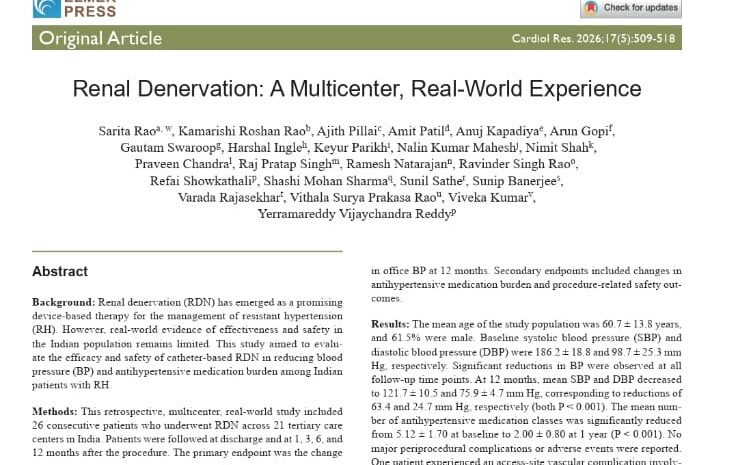
Renal Denervation: A Multicenter, Real-World Experience
Renal denervation (RDN) has emerged as a promising device-based therapy for the management of resistant hypertension (RH). However, real-world evidence of its effectiveness and safety in the Indian population remains limited.
This study aimed to evaluate the efficacy and safety of catheter-based renal denervation in reducing blood pressure (BP) and antihypertensive medication burden among Indian patients with resistant hypertension.
Methods
This retrospective, multicenter, real-world study included 26 consecutive patients who underwent RDN across 21 tertiary care centers in India.
Patients were followed at discharge and at 1, 3, 6, and 12 months after the procedure.
The primary endpoint was the change in office blood pressure at 12 months.
Secondary endpoints included changes in:
- Antihypertensive medication burden
- Procedure-related safety outcomes
Results
The mean age of the study population was 60.7 ± 13.8 years, and 61.5% were male.
Baseline:
- Mean systolic blood pressure (SBP): 186.2 ± 18.8 mmHg
- Mean diastolic blood pressure (DBP): 98.7 ± 25.3 mmHg
Significant reductions in BP were observed at all follow-up time points.
At 12 months:
- Mean SBP decreased to 121.7 ± 10.5 mmHg
- Mean DBP decreased to 75.9 ± 4.7 mmHg
This corresponded to reductions of:
- 63.4 mmHg in SBP
- 22.8 mmHg in DBP
Both were statistically significant (P < 0.001).
The mean number of antihypertensive medication classes was significantly reduced from 5.12 ± 1.70 at baseline to 2.00 ± 0.80 at 1 year (P < 0.001).
No major periprocedural complications or adverse events were reported.
One patient experienced an access-site vascular complication involving the superficial femoral artery, which was successfully managed with covered stent implantation without further sequelae.
Conclusions
RDN was associated with significant and sustained reductions in blood pressure and antihypertensive medication burden over 12 months.
The procedure demonstrated a favorable safety profile, supporting its role as a safe and effective adjunctive treatment option for patients with resistant hypertension.
Write a Comment